What is Wajima lacquerware?

Wajima lacquerware is a type of lacquerware produced in Wajima City, Ishikawa Prefecture, a small town with a population of just under 30,000, located at the tip of the Noto Peninsula.
It has a long history and is undoubtedly one of Japan's most representative lacquerware, having been the first lacquer product to be designated as an Important Intangible Cultural Property of Japan.
The robust and beautiful Wajima lacquerware is truly a traditional craft that can be used for a lifetime.
We will tell you about the characteristics and appeal of Wajima lacquer chopsticks.
Three characteristics of Wajima lacquerware
So, what exactly is Wajima lacquerware? We will explain its characteristics.
①High-quality lacquerware made using a unique manufacturing method
Wajima lacquerware is made up of over 100 manual processes.
Due to the large number of steps involved and the pursuit of work efficiency, division of labor has developed, and what was formerly the Six Wajima Crafts has now been divided into 11 different jobs.
Specifically, there are various occupations, including the lacquerer at the top, woodworker, base coater, sharpener, overcoater, roiroshi, makieshi, and chinkinshi. The finished wood base is then primed, polished, and overcoated, and finally the roiroshi, makieshi, and chinkinshi decorate it.
Indeed, craftsmen in each trade have perfected their first-class skills, and these skills are combined to create a single product.
② "Durability" due to multiple layers of paint
The strength of Wajima lacquerware is supported by the "Nunokase" method, in which raw lacquer and rice paste are used to attach hemp to the wood base to reinforce it, and by the application of a base coat of baked diatomaceous earth called "Wajimajinoko" mixed with raw lacquer and rice paste and then layered on top of it.
The durability of Wajima lacquerware is due to the solid base coat that is applied in multiple thick layers.
3. Traditional lacquerware with a long history
The oldest existing Wajima lacquerware is the vermilion-lacquered door of the former main hall of Juzo Shrine, which is said to have been made in the fourth year of the Taiei era during the Muromachi period. However, lacquerware products thought to date back to the Heian period or even earlier have been discovered in and around Wajima City, Ishikawa Prefecture, the birthplace of Wajima lacquerware, and its origins date back to ancient times.
The current techniques for Wajima lacquerware, designated as a traditional craft, have existed since the Kanbun era of the Edo period, and have been spread by both land and sea, taking advantage of the region's geographical advantages.
The appeal of Wajima lacquer chopsticks
Chopsticks are something we use every day, so using high-quality chopsticks can make your life feel a little richer.
This is a great item to have at home, and also makes a great gift for weddings, Mother's Day, Father's Day, etc.
We would like to introduce you to the chopsticks made by Wajima artisans that are sold at The Ichi.
Wajima lacquer chopsticks

Wajima lacquer chopsticks are made from natural wood with a base coat of Wajima powder and finished with natural lacquer. No synthetic resin paints are used.
These are truly authentic, durable, high-quality chopsticks.
Wajima lacquer chopsticks
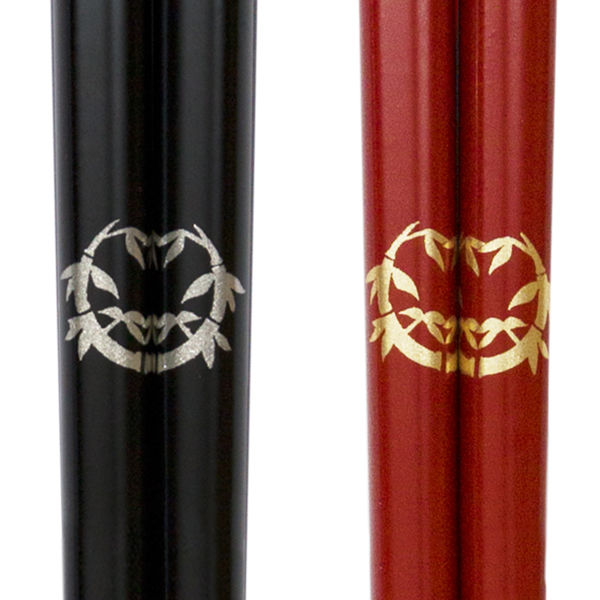
These chopsticks are not coated with a base powder, but instead use a synthetic resin paint for the undercoat, chopstick heads, etc., and then finished with a natural lacquer top coat. The top coat is applied by hand by Wajima artisans, and all parts that normally come into contact with the hands, including the part that goes into the mouth, are lacquered, giving them a luxurious feel. Furthermore, because they are not coated with a base powder, they are made extremely lightweight, making them perfect for everyday use.
Conclusion
The impact of the new coronavirus has hit tourist destinations across the country hard, including producers who sell their products to these destinations.
Traditional crafts that have been cherished throughout Japan's long history may soon be going out.
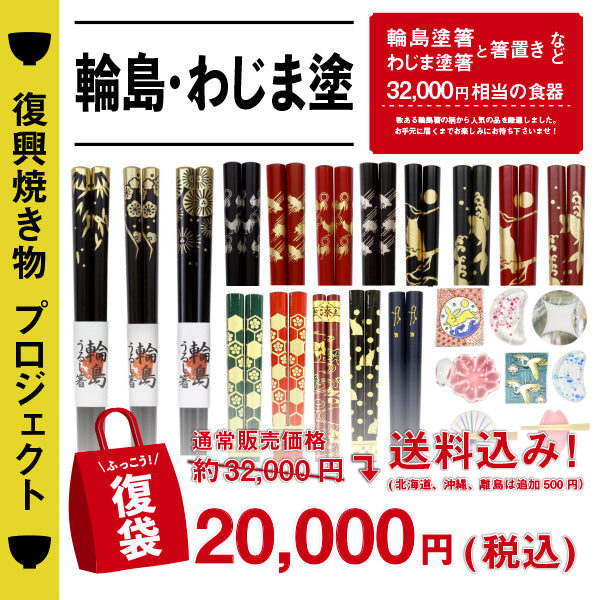
In order to keep that flame alive, we at The Ichi have prepared Wajima lacquerware restoration bags as part of our Pottery Restoration Project.
Please support us!