
I'm sure there are people who have multiple cats and those who don't. A cat is in the way and you can't stretch your legs...!! What a pain! Sometimes you just mercilessly move them away, but sometimes you end up not being able to move them and end up moving them yourself.
The history of cats and kotatsu, and children's songs
The origin of the kotatsu dates back to the Muromachi period
The kotatsu, a familiar table for Japanese people, has a long history, dating back to the Muromachi period.
The first kotatsu consisted of a hearth with the heat turned down, covered with ashes, and a slatted base with short legs placed on top, covered with a cloth. This would mean that if you weren't careful, you could get burned, and it seemed impossible to even let a cat inside.
Yagura Kotatsu, which appeared in the Edo period
During the Edo period, the "yagura kotatsu" appeared, which was made by cutting out a section of tatami mat, putting a charcoal fire underneath, covering it with ashes, and then erecting a yagura on top of it and covering it with a futon.
There is ample space between the entrance to the futon and the platform, allowing cats to stretch their legs. It is thought that this is probably when cats began to use kotatsu.
Later, because it was a hassle to cut out the tatami mats every time a kotatsu was made, movable kotatsus with a brazier and a stand integrated into one were introduced.
The sunken kotatsu table, which became popular during the Meiji period
In the Meiji period, the "sunken kotatsu" appeared.
Surprisingly, the inventor of the sunken kotatsu was not a Japanese person, but rather the British potter Bernard Leach, who was said to have had difficulty sitting upright, and proposed a kotatsu that could be used without folding the legs.
By the way, kotatsu at that time used charcoal as a heat source, so there was a risk of getting burned if you accidentally touched it. It seems a little unsuitable for cats to use.
Electric kotatsu became popular after the war

Electric kotatsu, which are commonplace today, only appeared after the war.
The heat source is an infrared lamp heater and a quartz tube heater, so now you can finally get warm in a kotatsu without the risk of getting burned. Another feature is that the heating element is smaller than a yagura kotatsu or sunken kotatsu, making it comfortable for both humans and cats to relax in.
Cats and kotatsu in nursery rhymes
A cat sitting in a kotatsu appears in the children's song "Snow," known for the opening line "Snow and hail."
This song about snow first began to be sung in 1911 (Meiji 44), more than 100 years ago.
This song was published in the Ministry of Education's "Ordinary Elementary School Songs" for second graders, and children all over the country must have been singing along. The first verse of this song ends with the well-known line, "Cats curl up in a kotatsu."
About cat-only kotatsu

Kotatsu, which is no longer seen these days
Sit under a kotatsu and eat mandarin oranges to warm yourself... it's a typical winter scene. During the Showa era, every household had a kotatsu, but when did they disappear?
There are many reasons why kotatsu are no longer used, such as the increase in nuclear families and changes in housing conditions. It's true that kotatsu take up a lot of space, so they're not suitable for small homes like apartments. If people don't use the kotatsu, cats can't relax in it either. While some homes in rural areas still have kotatsu, the reality is that cats in cities rarely see one.
That's where the cat-only kotatsu came in.
Cats and kotatsu are a perfect match.
It's dark, cramped, and warm - a paradise for cats! That's why kotatsu heaters made just for cats are so popular these days. While it's not necessarily true that if people don't use them, they should at least be made for cats, one pet supply manufacturer apparently sells a limited number of them every year, and they always sell out.
This cat-specific kotatsu table is adorable and very compact!
It's about 45cm wide, 35cm deep, and 30cm high, so it's full when a large cat fits inside. This means you can find space to set it up even in a small room. However, in homes with multiple cats, there will be fighting over it, so you may end up buying one kotatsu for each cat.
Furthermore, kotatsu for cats are designed with safety in mind. The heating element is covered and the heat is radiated so that the heat does not directly hit the cat. Furthermore, the temperature at the center of most products is set quite low, at around 30°C.
This way, even if the cat hides in the kotatsu and doesn't come out for a long time, the owner can still do housework and feel at ease.
Important points to note about kotatsu and stoves

Cats that are native to the tropics tend to dislike the cold.
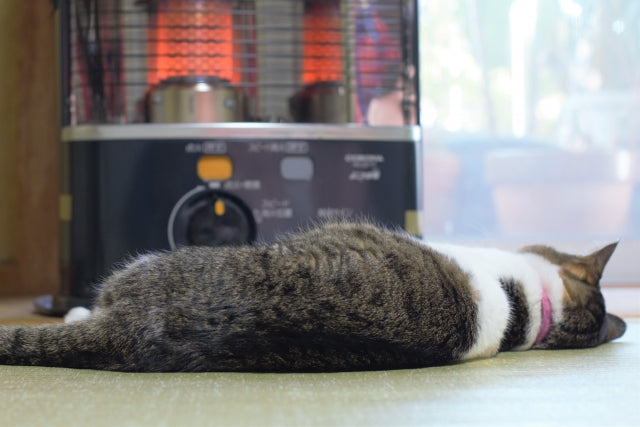
When you turn on the heater, you often see cats not only occupying the front of the heater, but also crawling tightly against it and not moving. Cats are actually a little insensitive to heat, and if they get too close to the heater because it's cold, they may burn their whiskers or fur.
Countermeasures include turning off the heater when no one is around and setting up barricades to prevent cats from getting too close.
Kotatsu tables do not generate as much heat as stoves, but cats may suffer low-temperature burns if they accidentally come into contact with the heating element.
Low-temperature burns occur when a cat is in contact with a temperature that is too low to feel hot to the touch for a long period of time, and can be quite dangerous as the burns can reach deep into the skin. Furthermore, kittens who are not physically strong or elderly cats who are insensitive to temperature can suffer from heatstroke if they stay in a kotatsu for a long period of time.
As a countermeasure, turn off the kotatsu when no one is there. In the first place, heat does not escape easily from a kotatsu that is covered with a futon, so leaving the kotatsu on for the cat's sake will actually have the opposite effect.
summary
Kotatsu, which cats love, has a long history, dating back to the Muromachi period.
Yagura kotatsu (a type of table with a raised base) first appeared in the Edo period, and it is believed that cats began to enter kotatsu around this time. Kotatsu also appear in a famous children's song that every Japanese person knows. However, kotatsu have become increasingly rare in recent years. So what's popular now is a cute, very small, and safe kotatsu made just for cats!


