

The origin of prayer beads
There are various theories about the origin of prayer beads, but the most popular is that the Brahman scriptures, which were created over 3,500 years ago, contain a reference to "renju" (a string of beads), which became the prototype for "nenju" (prayer beads). It is also said that Hindu believers also had the custom of using prayer beads to count the number of times they prayed. This custom was incorporated into Buddhism by Buddha and later spread to China.
Introduction to Japan
The introduction of juzu beads to Japan is believed to have occurred around the same time as the introduction of Buddhism from Baekje in 538 (although some sources say 552). The first documented mention of juzu appears in the materials ledger of Horyu-ji Temple in 743 (Tenpyo 19). The Shosoin Repository also contains a dragonfly-beaded juzu believed to have been a favorite of Prince Shotoku, as well as a pair of crystal and amber juzu beads that belonged to Emperor Shomu. A section of the Todai-ji Temple offering ledger from Emperor Shomu in 756 (Tenpyo Shoho 8) mentions juzu beads being donated as "national treasures." Juzu beads, crafted from precious materials such as gold, silver, amber, pearls, crystal, and pearls, were donated as national treasures and were highly valued as items aboard ships. For this reason, they were likely only used by a select group of monks and a limited number of aristocrats at the time.
Penetration among the general public
It wasn't until the end of the Heian period through the Kamakura period, when Buddhism was popularized, that juzu beads became popular as Buddhist implements among the general public, not just monks. Until then, Buddhism had placed emphasis on rituals and research for the state and aristocracy, but with the start of the Kamakura period, it became increasingly seen as a way to save the people, and sects known as "Kamakura Buddhism" emerged one after another, preaching simple teachings that lay believers could put into practice in their daily lives. Along with this, juzu beads were also improved to make them easier to use and suited the sect. It is said that most modern juzu beads were created during this period.
General sales of prayer beads begin
During the Edo period, Buddhism was established as the state religion, and all citizens were required to belong to a temple as a parishioner, leading to a rapid increase in demand for juzu. During the Genroku period (1688-1704), the general sale and purchase of juzu was officially permitted for the first time, and guidebooks on juzu appeared. It was also around this time that one-handed juzu, which had previously only been used by Zen monks, began to become popular among the general public.
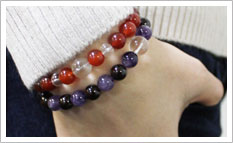
Shape of the prayer beads
The number of beads on a juzu is typically 108, representing the number of human desires, but currently there are various styles, such as 27 beads (a quarter of the number), or 18 beads in reference to the number 108, and these are called "informal juzu." The shape of formal juzu beads varies depending on the sect, but the most commonly used type consists of 108 main beads (omodama) and two parent beads (oyadama), with disciple beads (deshidama), dew beads (tsuyudama), and tassels attached to the parent beads. Four slightly smaller beads are placed in the middle of the 108 main beads, called the Shiten beads. In informal juzu, there are two of these beads, so they are called Niten beads.
Differences in prayer beads by sect
Shingon Buddhism
The basic form of Shingon Buddhist prayer beads is said to be the one given to Kobo Daishi by his teacher, Eka Ajari, when he returned from Tang China, and because of its shape, it is also called furiwake rosary. This type of rosary has become so widespread that it is used by sects other than Shingon as well, and is therefore also known as the eight-sect type. There is also the "hankurinenju" (half-reeled prayer beads) made with 54 beads for temple use. For lay people, the shape is slightly smaller, and the tassel is generally chrysanthemum-shaped.
Tendai sect
Most of the beads used in the Tendai sect are flat beads (flat beads like those on an abacus). They are made with 108 main beads, 1 parent bead, and 4 Shiten beads. The tassels have 10 round beads on one hand and 20 flat beads on the other.
Jodo sect
The Jodo sect uses a unique double-strand rosary, called the "Nichijitsu Juzu," which has two linked rings. It is said to have been invented by Awanosuke, a disciple of the monk Honen. It is an essential Buddhist accessory when worshiping Buddha or chanting the Nembutsu. One type of daijitsu rosary is known as the "Hyakumanben Daijuzu," which has 108 beads, each of which is made up of 100 strands. The basic shape of the sozoku rosary is slightly different, and single-handed rosaries are currently more commonly used for lay people.
Jodo Shinshu
The basic shape is the same as that of the Jodo sect, and is determined by the dimensions. In Jodo Shinshu, there is no restriction on the number of nembutsu recited, so there is no set number of beads. Jodo Shinshu prayer beads were invented by the founder of the sect, Rennyo, and the way the back tassel is tied is unique to this sect and is called the "Rennyo knot." Although the format is the same, there are special types called "for use by both the head priest and for missionary purposes." Those for lay people are also basically the same, and in addition to these, the usual one-handed prayer beads are also used.
Nichiren sect
Nichiren sect juzu use long strings of beads with 108 beads. Shorter juzu beads such as 64 or 27 beads are not used. The tassels are distinctive, and the shape of the tassels coming out of the main bead is asymmetrical. The juzu beads have three tassels or "lanterns" on the left side and two on the right side. Since the time of their founder, Nichiren Shonin, Nichiren sect juzu have been in the old style used by the Six Southern Buddhist Schools of Buddhism, including the Kegon sect, but it is said that the current style began to be used around the end of the Muromachi period. In Nichiren sect, tassel-style juzu beads are for monks, while believers use lantern-style juzu beads.
Zen Buddhism
In the Soto sect, 18 main beads are threaded between the parent bead, the facing bead, and the four heavenly figures, and a metal ring called "Hyakuhachikankin" is a distinctive feature. A tassel is attached to only one of the parent beads along with a "bosa." Lay people use the Hasshuyo juzu and the one-handed juzu. In the Rinzai sect, juzu beads with a similar shape to the Soto sect are used, but these do not have metal rings.
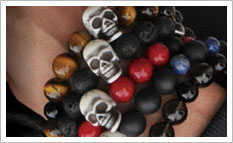
Prayer beads as fashion
Like wish-granting jewels, juzu beads are believed to have the divine power to ward off evil and bring good fortune, and it is believed that simply having one will ward off evil.Recently, bracelet juzu beads (wrist beads) have appeared, emphasizing this talismanic aspect and being enjoyed as a type of power stone for fashion.Bracelet juzu beads (wrist beads) are smaller juzu beads with a rubber or other similar thread that can be worn on the arm, making them shaped like a bracelet, and are not intended for use in Buddhist ceremonies as they were originally intended.




![Cherry Blossoms Every Moment ~ Cherry Blossoms Remaining ~ [Ring]](http://wargo.live/cdn/shop/products/13753_55151ea2-0d41-454e-93ac-c246d62e293b_{width}x.jpg?v=1675845467)
![Cherry Blossoms Every Moment ~ Cherry Blossoms Remaining ~ [Ring]](http://wargo.live/cdn/shop/products/13753_1_f709ad71-890c-442f-b1dc-3fe07427222d_{width}x.jpg?v=1675845465)
![[The Ichi(座市)]編集部のオススメ!今週の再入荷商品](http://wargo.live/cdn/shop/collections/shopify_{width}x.jpg?v=1678940879)
![Chrysanthemum earrings (kikka earrings) [Delivery time: approximately 4 months]](http://wargo.live/cdn/shop/products/1000200360002_{width}x.jpg?v=1678944363)
![[The Ichi(座市)]編集部のオススメ!水引細工特集](http://wargo.live/cdn/shop/collections/Banner_Mizuhiki_{width}x.jpg?v=1685944077)
![[The Ichi(座市)]編集部のオススメ!和柄ワッペン特集](http://wargo.live/cdn/shop/collections/Banner_Embroidered-badges_{width}x.jpg?v=1685695236)