

What are the ingredients in soap?
 Before we explain the ingredients of soap, let's first look at the raw materials used to make it. The basic ingredients of soap are natural oils and alkali.
You may think that's all there is to it, but if you look into the origins of soap, you'll find that something resembling soap was created by combining sheep fat and ash.
There are countless ratios of natural oils and alkalis, and the soap's cleansing power and lathering ability change depending on the ratio. You should choose the best ratio based on your skin type and purpose.
However, there are many types of natural fats and oils. These include vegetable fats such as olive oil, soybean oil, palm kernel oil, and coconut oil, as well as animal fats such as beef tallow and lard. Modern soaps generally use alkalis such as caustic soda (sodium hydroxide) and caustic potash (potassium hydroxide), and the reaction between the fats and alkali creates the soap base, the main component of the soap we use.
Soap is created by adding various ingredients to this main ingredient, but some people may think that additives are best and that additives are unnecessary. However, it is true that additives cannot be said to be bad in general. Are there any of you who are concerned about the moisturizing state of your skin? The moisturizing ingredients contained in soap are also additives.
Some people also place importance on the antibacterial properties of soap when washing their hands. Bactericides such as benzalkonium salts and triclosan are also additives, so it seems a bit unfair to generalize them as the bad guys. Soap contains a variety of ingredients, so let's take a look at the characteristics of solid and liquid soaps.
Characteristics of solid soap
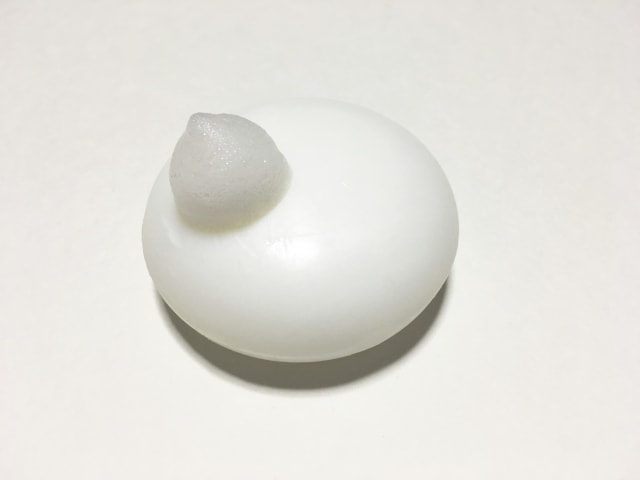 The features of solid soap that come to mind are that it's good value for money because it's hard and doesn't run out, and that it seems to have stronger cleansing power than other types. On the other hand, there are also other characteristics, such as cracking if left for a long time, and it takes a long time to lather.
Solid soap is made from sodium fatty acids, which are made by reacting oils and fats with sodium hydroxide (caustic soda). Therefore, strictly speaking, it is less irritating to the skin than liquid soap. However, the irritation level varies depending on the ingredients and formulation, so it can be said that there is not much difference between the two in actual use.
If you continue to experience strange tingling sensations on your skin, it is likely that the soap itself is not suitable for your skin type. You should try switching to a soap with different additives or a pure soap without additives.
Bar soaps are hard because they contain less water and a higher proportion of pure soap. Pure soap refers to the cleansing ingredient, fatty acid alkali salts, and bar soaps with 90% pure soap content can be said to have stronger cleaning power than liquid soaps. However, the key point is that fatty acid alkali salts dissolve in water and become surfactants, exerting their cleaning power.
A small amount of water will not provide a strong cleaning effect, which is why you should lather up solid soap thoroughly.
Characteristics of liquid soap
 Liquid soap is very convenient, as it only takes one push from the bottle and, unlike bar soap, you don't have to worry about other people using it.It is made from potassium fatty acids, which are produced by reacting oils and fats with potassium hydroxide (caustic potash).
Potassium fatty acids are easily soluble in water, and although it only contains about 30% pure soap, it has excellent power to remove stubborn stains and unpleasant odors. It is also not as harsh on the skin as bar soap.
However, when comparing cost performance with bar soap, it is somewhat inferior. Bar soap has an advantage in terms of the purchase price per product and the percentage of pure soap content.
However, in busy everyday life, the speed of liquid soap is key. The benefits of liquid soap, which lathers faster than solid soap and removes unpleasant odors quickly, are hard to give up.
Some people may think that simply dissolving solid soap, which has a high cleaning power, to make liquid soap is all good. It's fine to try making it after understanding that the ingredients of the solid and liquid soap are different, but I don't really recommend it.
This is because it will not turn out to be the same liquid soap as the product you are imagining. The reason why liquid soap contains about 30% pure soap is because if the percentage is higher than that, it will harden. However, if you dissolve less solid soap, you cannot expect sufficient cleaning effects.
Please note in advance that this product is intended for people who find solid products difficult to use, and who are okay with something that is not the same as the product as long as it is not solidified.
summary
 Both solid and liquid soap have their advantages and disadvantages, and one is not necessarily better than the other.
Of course, it's good to use it with care,
Why not take advantage of the features we have introduced here and incorporate them into your lifestyle?

![[The Ichi(座市)]編集部のオススメ!今週の再入荷商品](http://wargo.live/cdn/shop/collections/shopify_{width}x.jpg?v=1678940879)

![[The Ichi(座市)]編集部のオススメ!お肌の日特集](http://wargo.live/cdn/shop/collections/feature_banner_skin_day_1_{width}x.jpg?v=1671412344)
![[The Ichi(座市)]編集部のオススメ!お風呂の日特集](http://wargo.live/cdn/shop/collections/feature_banner_bath_day_{width}x.jpg?v=1671435240)


