

Are there really this many?
When we think of an obi, we imagine it wrapped around the waist when wearing a kimono or yukata. However, looking back through history, it has also been used to hold tools. You've probably seen samurai sashes in period dramas, with their Japanese swords tucked into their obi. Because of this history of the obi, the word "obi" is also used in the expression "obiru" (to wear), meaning to place it closest to the body, or to carry it. Over time, the meaning of "obiru" has evolved to "to decorate," and various patterns are given as accents to a complete outfit, sometimes even for decorative purposes. With such a long and profound history, if you're looking for a yukata for summer and wondering what kind of obi to choose, we'll introduce the types of obi that are essential when wearing a yukata.
Fukuro obi
The fukuro obi, which is worn with tomesode, houmongi, and furisode, is the longest obi in terms of both width and length. It is often worn at celebratory occasions, such as with tomesode at weddings and furisode at coming-of-age ceremonies. It is made longer because it is tied with a double drum, which symbolizes the wish for continued joy, and decorative knots that decorate gorgeous occasions.
Nagoya obi
Nagoya obi is an obi that is often paired with komon and tsumugi kimonos, and is often paired with kimonos known as "everyday wear." It is characterized by its width being between a fukuro obi and a half-width obi, and its length being the shortest. Because it is an everyday wear obi, it is easy to tie, and is therefore lighter than a fukuro obi, making it the easiest to tie.
Half-width obi
Half-width obi, which is worn with komon, tsumugi, and yukata, is by far the narrowest in width, but is the second longest after fukuro-obi. In fact, it is an obi that can be worn all year round, and may be the most useful obi! In recent years, designs have become more diverse, and it is also used in casual settings. It is now made longer so that it can be tied in a more elaborate way.
Half-width obi can be used for a variety of occasions, from casual kimonos to yukatas! We will introduce half-width obi that are often seen in casual settings, including yukatas.
Small pouch obi

The small bag obi is bag-shaped and made by sewing the edges of two pieces of fabric together. The patterns on the front and back are different, so it's an obi that kills two birds with one stone and can be worn either way. This obi can be worn not only with yukata but also with kimono, so it might be an obi you'll want to have!
Single-layer obi
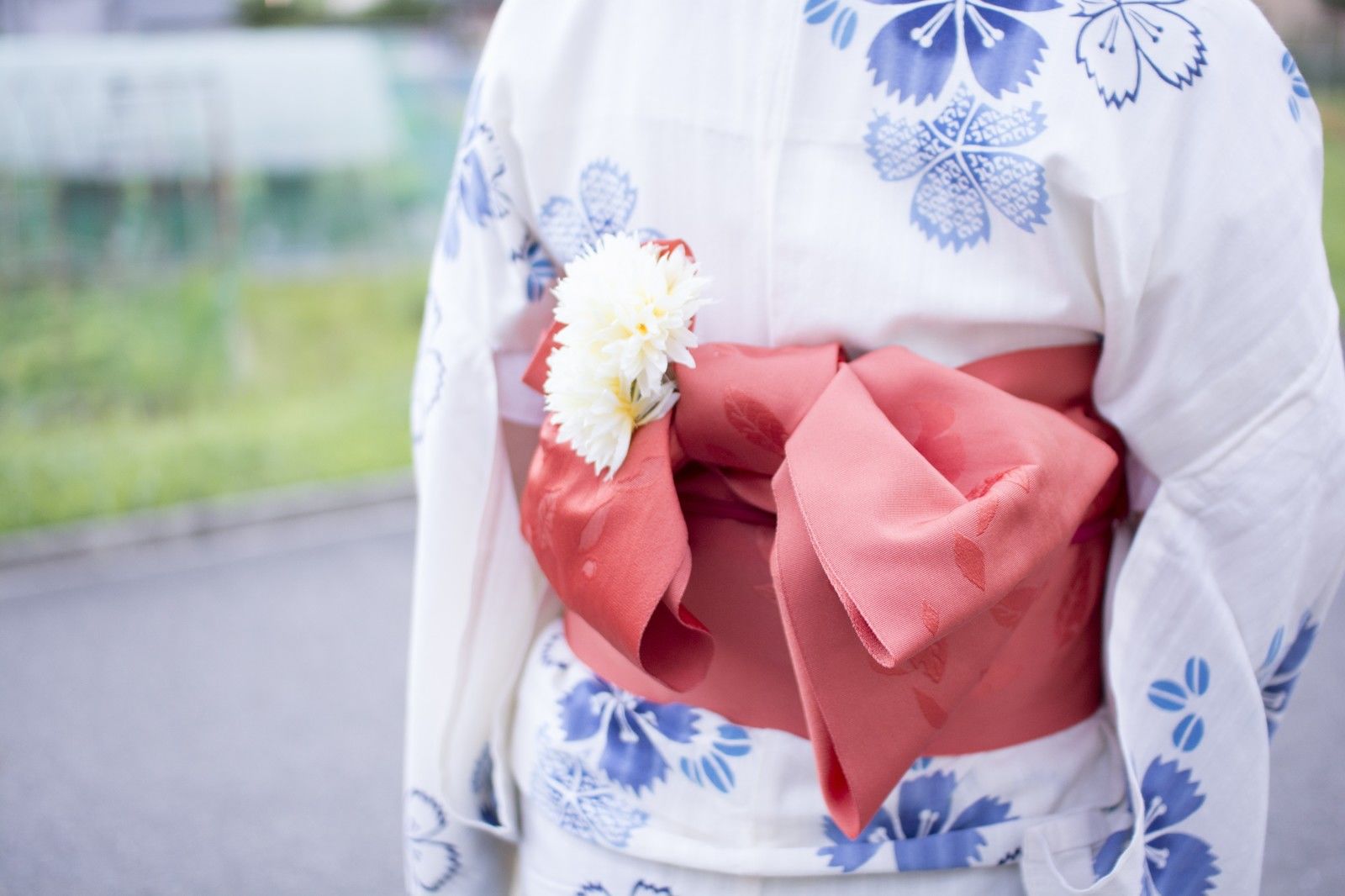
This is the obi most commonly used in yukata scenes. It is about half the thickness of a small pouch obi, so it is used for lighter outfits. There are a wide variety of designs, and many people are enjoying total coordination with designs that include glitter processing or leaving the lining out!
Pre-made obi

This obi is the answer to all those problems: "I can't tie my obi when I want to wear it," "I'm afraid it will come undone because I drive," and "I'm worried it will come undone when I'm out with my kids." The obi has separate parts, one that wraps around the waist and one that tucks into the back, so anyone can easily create a beautiful look. The obi is fixed in place, so there's no need to worry about it losing its shape! Recently, pre-tied obi other than ribbons have become more common.
It's the season for summer festivals, fireworks displays, and wearing yukata. The obi is what makes a gorgeous yukata look even more beautiful and chic. There are many ways to show off your yukata, depending on the color, material, and pattern. I think there are countless ways to coordinate it with your yukata. This time we've only introduced a small selection, but we sincerely hope that the obi you pick up when putting on a yukata this summer will be the one that really brings out the best in you. Also, have fun with your outfits this summer and stand out from the crowd, so be sure to choose the right obi when you do so!


