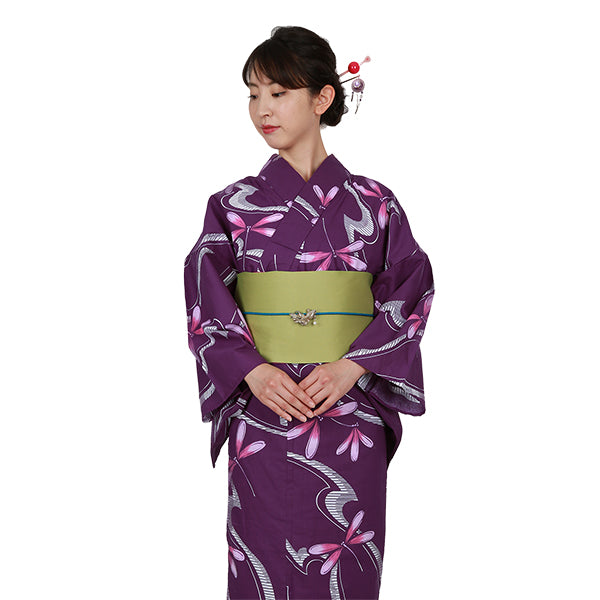
Did you know that one particular insect is often used in designs for summer kimonos and yukatas? It's the dragonfly. It's an insect that is very familiar to Japanese people, such as the red dragonfly that can be seen around the time of Obon. In fact, "red dragonfly" is a general term for dragonflies with red bodies and is not a specific name, but leaving that aside, we have compiled the meaning behind how it is used as a design. It is used for reasons other than its familiarity. Let's take a look now!
Insects that were called "victory insects"
You might be surprised to see an insect on a yukata or kimono!? But dragonflies are a standard pattern for kimonos. Because dragonflies can only move forward and cannot retreat, they are said to be fearless, competitive insects that bring victory, and are called "victory insects." However, there are other insects that have also been called victory insects. Take the centipede, for example. It is written in kanji as "mukashi" (hundred feet), and with a hundred legs, it certainly seems difficult to retreat. Although also a "victory insect," dragonflies are the only insect chosen for kimonos and yukatas. While there are design issues, such as the fact that they can look too scary, there seems to be a little more to why they were designed and became such a beloved kimono pattern for so long.
Japan = Dragonfly!?
The Chinese character for dragonfly is "Tonbo," which can also be read as "Akizu." It appears in the Manyoshu as another name for Yamato Province, or Dragonfly Island, as in "Umashikuni so Akizu (Tonbo) Island, Yamato Province." Originally, Wakoku was called Akizu Island, and the name was a pun on the word for dragonfly (Akizu). According to legend, when Emperor Yuryaku (reigned 456-479) went hunting in Yoshino, Nara, a horsefly came and bit him on the arm. A dragonfly came along, ate the horsefly, and flew away. The Emperor then wrote a song saying, "A horsefly attached itself to the temple of my hand, and a dragonfly (Akizu) immediately devoured it, and thus the dragonfly was named after him. And so the country of Soramitsu Yamato is called Dragonfly Island."
The origins of kimono and yukata patterns
Dragonflies fly in swarms in the autumn, which led to them being considered "symbols of grain spirits" and prayers for a bountiful harvest. In terms of practical benefits, they were apparently valuable beneficial insects that were indispensable for rice paddy cultivation, removing pests, and there are examples of them being engraved on bronze bells from the Yayoi period. In other words, as a symbol of prosperity and a prayer for a bountiful harvest, they were probably incorporated into kimono and obi patterns as auspicious designs. As you may know, auspicious objects are incorporated into kimono patterns such as "pine, bamboo, and plum" and "noshi."
summary
What do you think? It was a little trip through history. It's quite romantic to think that these stories have been passed down from ancient Japan, designed as lucky charms, and now become the patterns of the kimonos and yukatas we wear today. If you are particular about the material and design of your yukata, why not consider the patterns when choosing one?