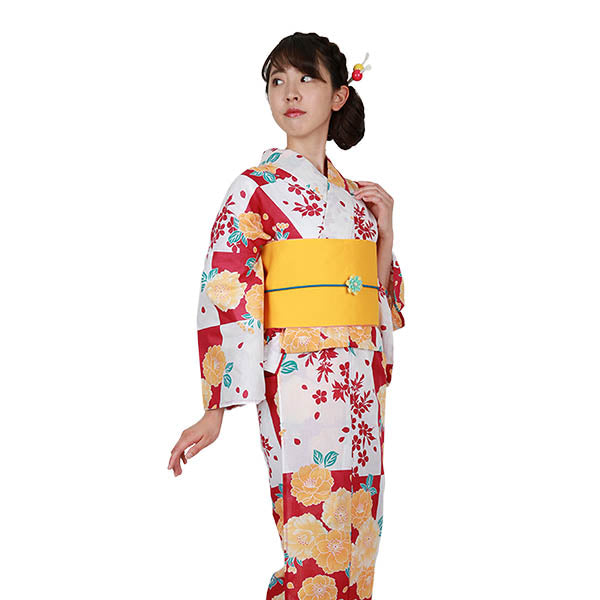
The checkered pattern is considered a traditional Japanese pattern.
It is also used in the Olympic logo and is considered a "Japanese pattern," but because of its simple design of squares arranged in a grid, the same pattern is also known as a "checkered pattern" in the West and is equally familiar. In today's increasingly Westernized world, both "checkered patterns" and "checkered patterns" are equally familiar in Japan. Why do we feel that the checkered pattern is so Japanese, even though it is the same pattern? Despite its simplicity, the checkered pattern is imbued with many auspicious meanings. Let's take a look at the origins of the familiar checkered pattern!
The birth of the "checkered pattern"
Although the pattern has been used since ancient times, and was featured on the clothing of haniwa clay figures from the Kofun period, it is surprisingly only relatively recently that the pattern of squares arranged in a grid pattern has come to be called the "checkered pattern." The name comes from the fact that in 1741, a popular kabuki actor named Sano Ichimatsu, who was known during the Edo period, wore hakama featuring this pattern as his trademark.
In earlier times, it was more familiarly known as "cobblestone" or "hail" rather than "checkered pattern." The reason this pattern has so many names even in Japan may be because, despite its simplicity, it can be likened to a variety of things.The "good luck" embodied in the checkered pattern
Like New Year's dishes, traditional Japanese things always have a meaning embedded in them. Of course, traditional patterns are no exception, and checkered patterns are imbued with a special sense of good fortune. Because the checkered pattern is a seamless pattern that continues endlessly up, down, left, and right, it is considered an auspicious pattern that brings prosperity to descendants and business expansion.
As mentioned earlier, the checkered pattern is also used in the emblem for the 2020 Tokyo Olympics, and the auspicious meaning of the checkered pattern is embedded in it. Unlike the usual checkered pattern, which is made up of squares of the same shape combined together, the emblem is made up of three different types of squares. This represents the "diversity that comes from the involvement and expansion of many cultures and countries." Although "checkered patterns" and "checkered patterns" look the same, there are differences in the meanings they contain. Perhaps this is why we unconsciously sense "Japanese" and "Western" styles.summary
What did you think? The checkered pattern is a simple yet long-standing traditional pattern that has been passed down for a long time. It blends in well with both classic and modern patterns, and looks good on both men and women! How about coordinating it as a pair, whether it's with your parents and children, friends, or couples? Finally, we'd like to introduce some yukata featuring the checkered pattern, so be sure to take a look!